
Beauty Industry Study Reveals Higher Paychecks


Source: Qnity
When Erin Kuhn, Qnity president and spokeswoman for The Qnity Institute, took the stage at the annual Serious Business conference in New Orleans in January, she told the story of “Adam,” a stylist who came to the Qnity team with a decision to make.
“Adam wanted to know whether or not he should leave his current salon for a better-paying position,” Erin told the audience.
But in order to do that, he needed to make an informed decision. And Adam didn’t fully understand his compensation. Upon investigation, the Qnity team, along with Adam learned Adam was earning $147k a year (spoiler alert: he stayed at his salon).
Adam’s story and others like him led the Qnity team, led by Qnity Founder/CEO Tom Kuhn, to take drastic measures to address two major issues in the beauty business: a lack of data and a lack of financial literacy.
Finding Accurate Compensation Data
For decades, Qnity has provided education surrounding finances and growth to salon and spa professionals. Last year, the Qnity team formed The Qnity Institute, dedicated to creating economic empowerment for the professional beauty industry, through actionable data and financial literacy. This is the first of many initiatives the Institute will take on to make accurate information about a career in professional beauty easily accessible and readily available.
The Institute’s first project was to clarify compensation in the beauty industry.
“In my research, I have become increasingly alarmed to find much of the data about the beauty industry made available to the public is incomplete, flawed, and/or biased,” says Tom.
“Accurate data about compensation is vital to the sustainability of the industry.”
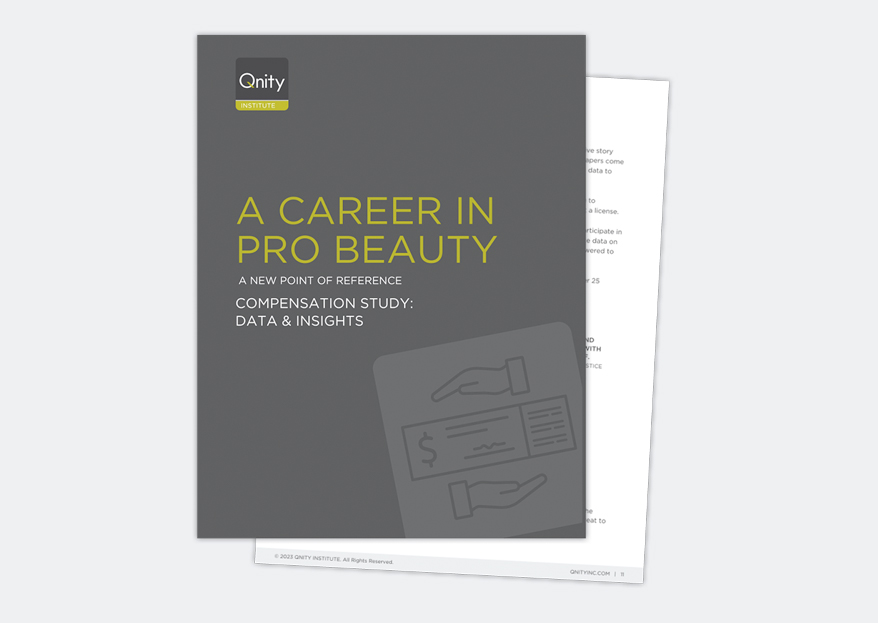
Tom and his team at the Qnity Institute started a grassroots study to equip salon owners with the data they needed to communicate earnings to their staff. This research quickly evolved into something much bigger: The Pro Beauty Compensation Study (Study).
The Study was conducted across 36 states in 330 salon locations, representing $184 million in payroll compensation with many industry organizations, including Aveda and Neill Corporation, stepping up to sponsor, advocate or help outreach efforts. Owners submitted the W2 earnings of 3,391 employees and completed a 50-question survey with qualitative and quantitative information. The survey was written by the Study team and rigorously reviewed by a think tank assembled to reveal any methodology errors and biases.
Source: Qnity
High Wages, Great Opportunities
The Study findings were staggering. Previously published statistics on beauty professionals showed low hourly wages and little opportunity for growth. The Bureau of Labor Statistics reported wages of $17/hr and the Century foundation reported average yearly earnings of $16,600.
The Qnity Institute’s Study tells a very different story:
- The average hourly rate for a salon professional is $38.37/hour
- 24 percent of those surveyed earned more than $48.08/hr—the amount necessary to earn $100k+/year if adjusted to a 40-hour work week.
- The average W2 was $54,307, but if adjusted to full-time hours, that went up to $79,807
- Beauty pros enjoy flexibility in their hours. The average amount worked was 27.8 hours per week, and 99 percent of owners offer scheduling flexibility.
- 96 percent of salons are offering benefits to employees and 90 percent offer new hire training programs/ongoing education.
But perhaps the most exciting find in the Study was the potential and stability the beauty industry offers. There are 30+ careers available to beauty pros and 94 percent of businesses are hiring.
“We were surprised by the amount of companies with full-time hours available—a stark contrast to other industries doing mass layoffs and contracting their workforce,” says Erin.
“There’s a level of job security in the beauty industry that other jobs don’t provide.”
8 Key Findings

Source: Qnity Facebook
The Pro Beauty Compensation Study isn’t just about numbers. Eight key findings about the salon industry were examined: Earnings, Flexibility, Benefits, Training, Inclusion, Possibilities, ROI and Passion.
“Compensation is about so much more than a paycheck,” says Erin. “And the job opportunities are vast.”
The Study found 94 percent of the businesses they surveyed had positions open for service providers and 70 percent had positions open for support staff.
For those who don’t want to work in a salon, there are careers in film, tv, beauty brands, education, specialized areas and much more.
The best news of all? The Study found it just takes an average of four to six years for beauty pros to pay back their student loans. And because earnings rise with years of experience in the industry, it’s likely graduates will experience a short path to high earnings.
Get the Full Report
Want to learn more? The full report is available and you can tap into all of the data in the Pro Beauty Compensation Study by downloading the report here.
The beta phase, phase 1 and phase 2 of the Study were completed in 2022. This year, the Qnity Institute will complete phase 3, using data to identify trends, expand to include other segments of the workforce and increase the number of data points. Want to participate? Click here.
Bring Financial Wellness Training to Your Business
Do you have employees like Adam, who don’t fully understand their compensation? Qnity offers financial wellness training through their MONEY by Qnity product offerings for you and your team. Click here to learn more about working with Qnity.
Comments
-
Related Articles
-

Locals Only: Stylists Star in Neill’s Education Nights
When it comes to education, Neill has always been an innovator and leader, giving its network of salons access to top educators and a wide range of technical and business education in a variety of formats […]
READ MORE »
-

Beyond Technical: Aveda Education is Big Picture
Addressing salon culture is a priority for successful salons, paying off in dividends for those who understand its importance. Because of the impact a strong culture can have on a salon, Aveda has created educational opportunities– above and beyond technical education– for its salon network. Salon owners who take advantage of these classes […]
READ MORE »
-

Serious Business 2025: The Evolution of You
Serious Business 2025’s conference theme, “Evolve,” focuses on personal and professional growth. Through insightful speakers and interactive sessions, attendees will explore adaptation, mindfulness, and leadership.
READ MORE »
-